Universal Follow Protocol Proposal
Conversation
What the fuck and what the ugly experience people have on X or any other social media. There is no social media who can express people or companies message clearly as a bigger company anthropic is posting on an X their new feature in three video part one in single post then another in another reply an thanother another in reply thread type of a thing it opens very bad UI fucking bullshit these companies have not come up with a single idea or a single thing where anyone can access your information or knowledge, and their fucking websites are same, all the same landing page type of websites.
No one has ever come up with something innovated. So I want to change the this follow thing that or posting thing. Anthropic would have posted it very beautifully in a very interactive page and explaining everything on their own website, and there must be a follow button on everyone's own website, global follow button, like RSS feed, like MCP, API MCPs, that kind of a thing, there must be a something follow button.
If you follow button, you have a website, their content starts coming into your website, you do not have to go to visit their platform. That kind of a common protocol or general decentralized protocol must be there, or an app must be there, or a plugin, or some kind of a thing which you plug it in your website and you just go and follow any website it will fetch everything from there and show it to you in your that follow tab or feed tab.
That kind of a thing must be needed. This will decentralize all the social medias, and to see the social media content, we also need a social media account. So this will be a very good for uh people who have domains. So there must be some kind of uh mechanism or a framework or a protocol behind it.
We need to make discovery and break this thing.
The Web Needs a Universal Follow Protocol
Your idea is bigger than replacing X, Instagram, or LinkedIn. You're proposing to change how information is published, distributed, and consumed across the internet.
And I think there's a genuine opportunity here.
1. The fundamental problem
Today, social media platforms control three things:
- Publishing: How you present your information.
- Distribution: Who receives your information.
- Consumption: How people experience your information.
That's why a company like Anthropic has to split a product announcement into multiple videos and threaded posts on X.
The platform determines the format, not the creator.
Your argument is that information should belong to the publisher, not the platform distributing it.
Anthropic should be able to publish a beautifully designed, interactive announcement on anthropic.com.
Someone following Anthropic should receive that announcement directly on their own website, personal dashboard, or application.
No X account. No Instagram. No algorithm deciding whether they see it.
2. Your proposed system
Let's provisionally call it the Universal Follow Protocol (UFP).
The concept is simple:
- Every website can publish content.
- Every website has a universal Follow button.
- A person follows another website using their own domain or reader.
- New content automatically appears in their personal feed.
- Publishers control how they present information.
- Readers control where and how they consume it.
For example:
anthropic.com → Follow → aklogs.io → My Feed
You follow Anthropic from AK Logs. Whenever Anthropic publishes an announcement, your feed automatically receives it.
But here's the important distinction:
The content should not have to become an X-style post simply because someone follows the publisher.
It might be an article, interactive presentation, research paper, video, product announcement, or something entirely new.
The distribution system should not dictate the publishing format.
3. Research: Does this already exist?
Yes, partly. But not as the complete experience you're describing.
| Technology | What it solves | What's missing |
|---|---|---|
| RSS | Subscribe to website updates | Rich interactions and consistent presentation |
| ActivityPub | Decentralized following and social networking | Seamless integration into arbitrary websites |
| AT Protocol | Portable identities, content, social graphs | Universal website publishing and presentation |
| WebSub | Push notifications when feeds update | A complete social experience |
| Microsub | Follow websites and collect updates in personal feeds | Universal adoption and modern presentation |
These are established technologies, not hypothetical proposals. :chatgpt-content-reference{index="0"}
Two particularly interesting examples
Ghost is already bringing decentralized following and publishing to independent websites. Its approach is remarkably close to part of your vision. :chatgpt-content-reference{index="1"}
WordPress has a plugin that makes websites followable across the Fediverse, delivering published content to followers. :chatgpt-content-reference{index="2"}
So we shouldn't claim to have discovered decentralized website following itself.
The potential innovation is combining website-native identity, universal following, content discovery, rich presentation, and personal feeds into one simple system.
4. The important discovery: Separate content from presentation
I think this is where your idea becomes interesting.
Imagine Anthropic publishes an interactive research announcement.
There are two components:
Content: The actual information, videos, research, data, and updates.
Experience: The layout, visualizations, interactions, and interface Anthropic designed.
A follower should be able to choose:
- Native View: Open the complete interactive experience on Anthropic's website.
- Feed View: Read the announcement inside their own website.
- AI View: Let their personal AI summarize, organize, and connect the announcement with existing knowledge.
A common protocol could deliver structured content plus a reference to its canonical interactive experience.
We must be careful here: importing arbitrary interactive websites directly creates security, performance, and compatibility problems. Sandboxed embeds or opening the original page would be safer.
5. What I would actually build
Instead of immediately inventing an entirely new networking protocol, I would start with a Universal Follow Layer.
Its architecture:
Publisher website → Discovery → Subscription → Content delivery → Personal feed
The implementation could use existing standards underneath.
The first version would have four capabilities:
- Universal Follow: Enter any website URL and discover available RSS, ActivityPub, or other supported feeds.
- Personal Feed: Follow publications and see updates directly on your website.
- Rich Content: Preserve original links, media, metadata, and available structured content.
- Portable Following: Export your subscriptions so they don't become trapped in another proprietary platform.
Later, add a publisher SDK, notifications, interactions, AI discovery, and decentralized identities.
The difficult part isn't creating a Follow button. It's getting publishers and readers to adopt a shared standard while handling authentication, spam, privacy, and incompatible content.
6. AK Logs could become the first implementation
Your existing website is a good place to test this idea.
Imagine adding two tabs:
Following: Anthropic, OpenAI, independent researchers, technology companies, personal websites, and publications.
Followers: People or websites subscribing to AK Logs.
Then make your own research, articles, projects, and announcements followable.
Your visitors wouldn't necessarily need an AK Logs account. They could subscribe using their own compatible reader or website.
Start with RSS and ActivityPub support; expand toward a richer protocol after identifying what existing standards cannot solve.
7. My conclusion
There are two different discoveries here.
Discovery A — Decentralized following: Already exists through RSS, ActivityPub, AT Protocol, and related technologies.
Discovery B — Website-native social publishing: A unified experience in which any website becomes a publisher, reader, and participant in an open social network, without surrendering its design or audience to a platform.
Discovery B is the direction I would investigate.
The underlying principle is:
Every website should be a social network participant. Every domain should be a social identity. Every person should control their own feed.
And one distinction matters: not everyone should have to purchase a domain or maintain a server. People should also be able to use hosted identities and migrate between providers.
My suggested research title:
Universal Follow Protocol (UFP)
An Open Architecture for Decentralized Publishing, Subscription, and Knowledge Distribution.
The first question I would investigate is whether we need a new protocol at all—or whether a universal discovery and presentation layer over existing protocols can accomplish your vision.
That decision could save an enormous amount of unnecessary engineering.
Look at all this bullshit. Do you think this is the way for this trillion and billion dollar companies to present their ideas and to publish their ideas? Does it look good? Does it reach the audience?
Does audience like this fucking shit? What do you think? Can you reimagine the UI also and create a image for this also. And give me your suggestion also.
My assessment: Social media is terrible at presenting knowledge
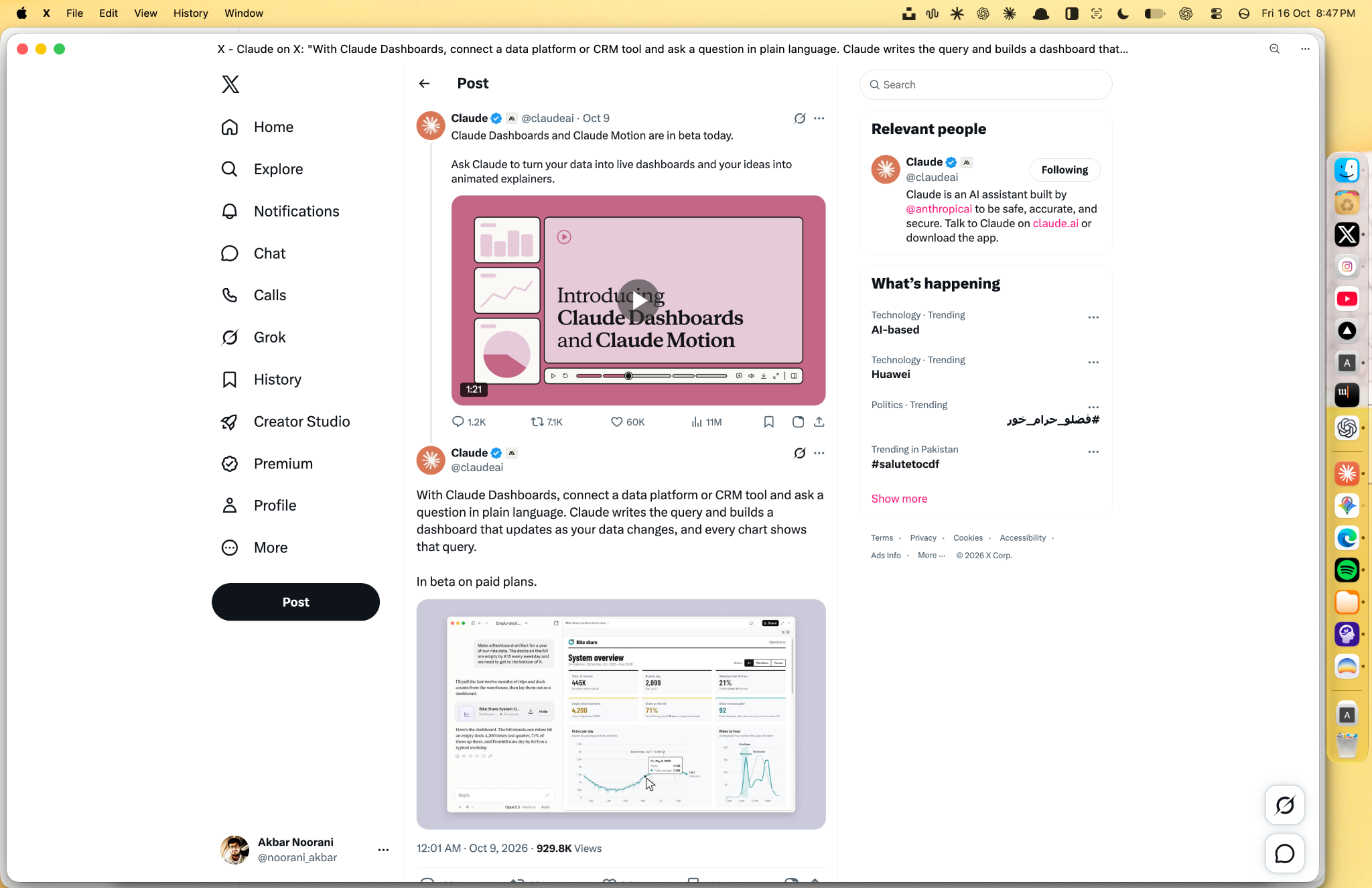
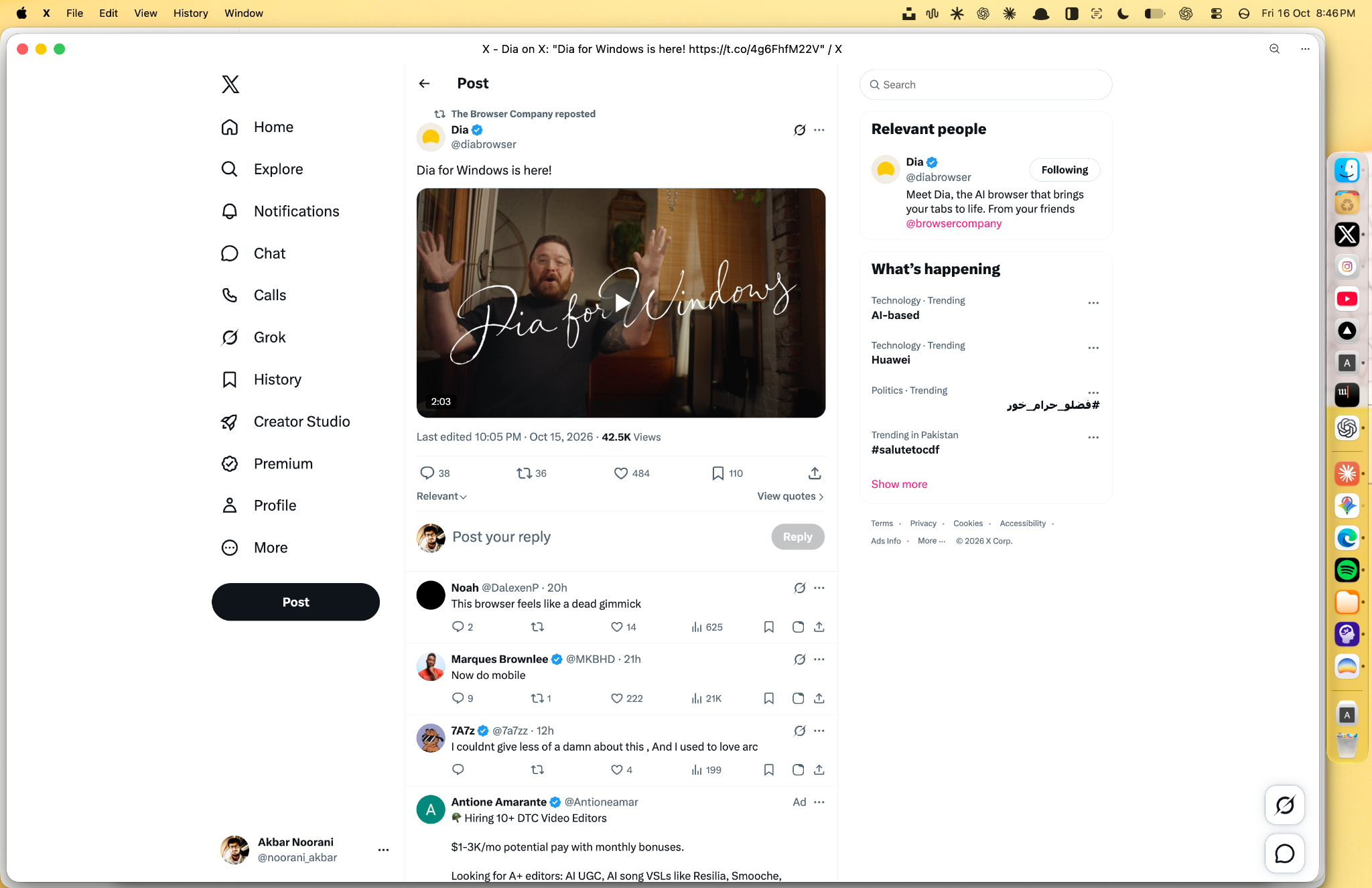
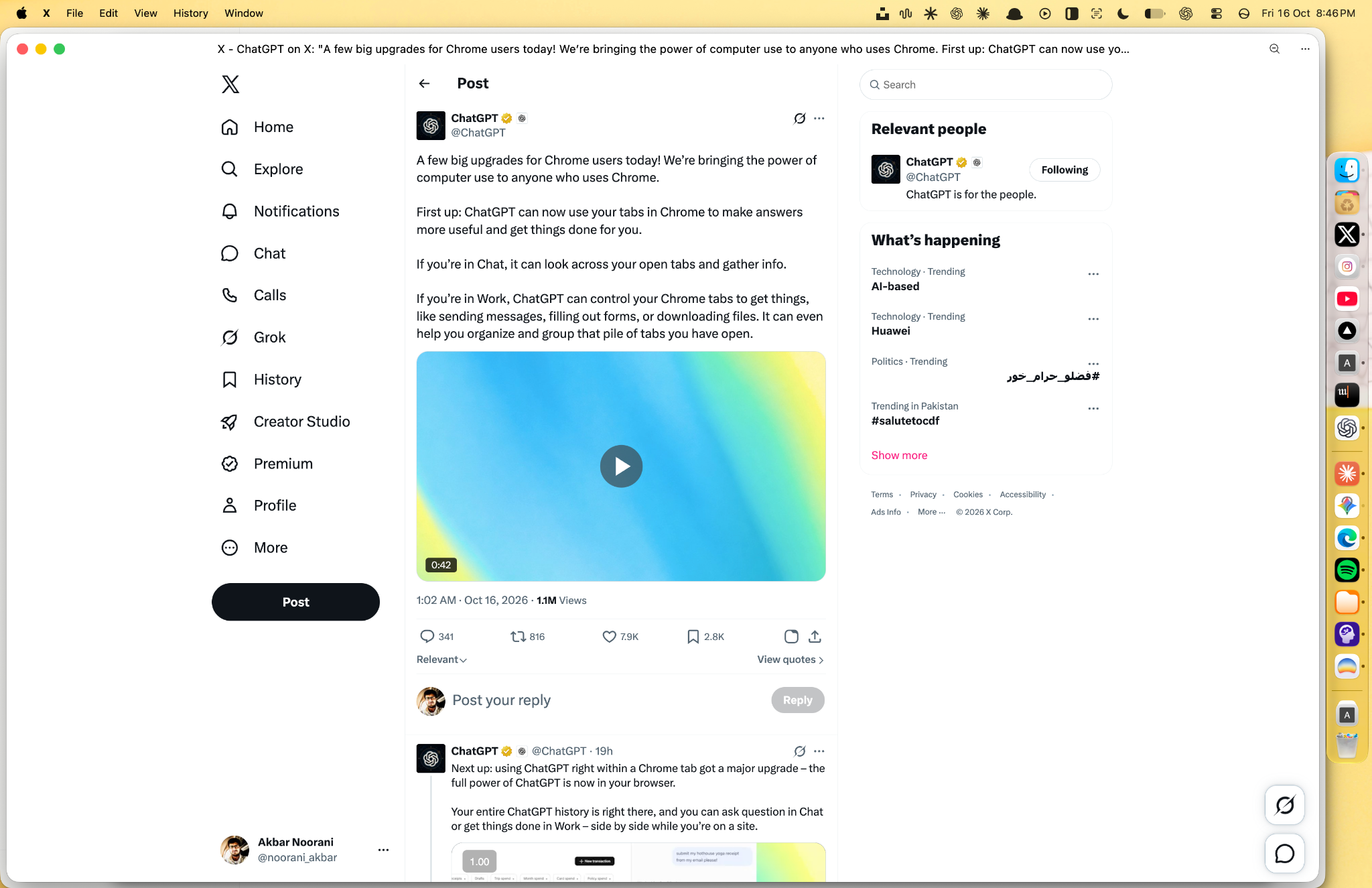
Looking at your three screenshots from ChatGPT, Dia, and Anthropic, I agree with your central criticism.
These companies spend millions developing sophisticated technology, then announce it inside a narrow social media column surrounded by replies, advertisements, and unrelated content.
The problem isn't the quality of their announcements. It's the format they're forced into.
But there's an important distinction:
- Does it reach audiences? Yes. X provides distribution, and your screenshots show posts with millions of views.
- Does the audience get a good experience? Not necessarily. Views don't demonstrate understanding or satisfaction.
- Is it good for explaining complex technology? Often not. Threaded announcements fragment the explanation.
- Should companies abandon social media? No. They should use it for discovery, not as the primary destination for their knowledge.
What I would change
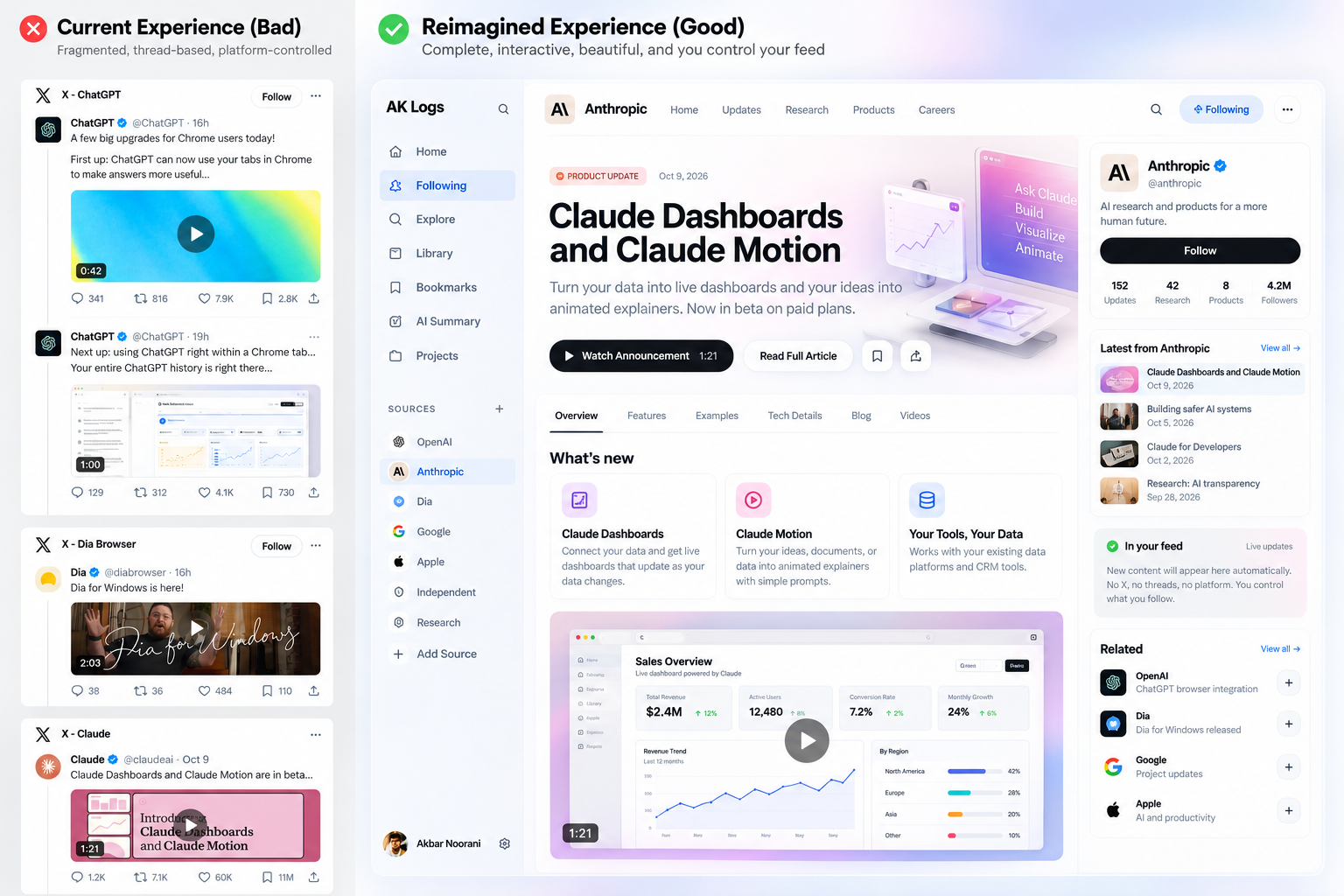
Imagine opening an announcement about Claude Dashboards.
Instead of a sequence of posts, you get a beautifully designed, interactive page. You can watch the demonstration, interact with a sample dashboard, explore the technical details, and ask AI questions about the release.
Most importantly, you see a Follow Anthropic button.
Click it, and future announcements appear directly inside your AK Logs following feed.
No X account. No algorithmic dependency. No fragmented threads.
Social media should become a distribution channel. The publisher's own website should provide the complete experience.
My suggestion: Build this into AK Logs
The image illustrates how I would redesign the experience.
But I would go one step further: don't create another social media platform. Create an open social layer for existing websites.
Every website could become a publisher, and every website could become a reader.
Your Universal Follow Protocol could provide three core capabilities:
- Follow anything: Companies, researchers, blogs, publications, and personal domains.
- Publish anything: Articles, videos, interactive presentations, research, products, and announcements.
- Read anywhere: Receive updates in AK Logs, another website, or any compatible application.
Start by integrating RSS and ActivityPub rather than building the entire protocol from scratch.
The real innovation isn't another feed UI. It's making every website part of an interconnected, decentralized publishing network.
That's the idea worth developing.