
About this chat
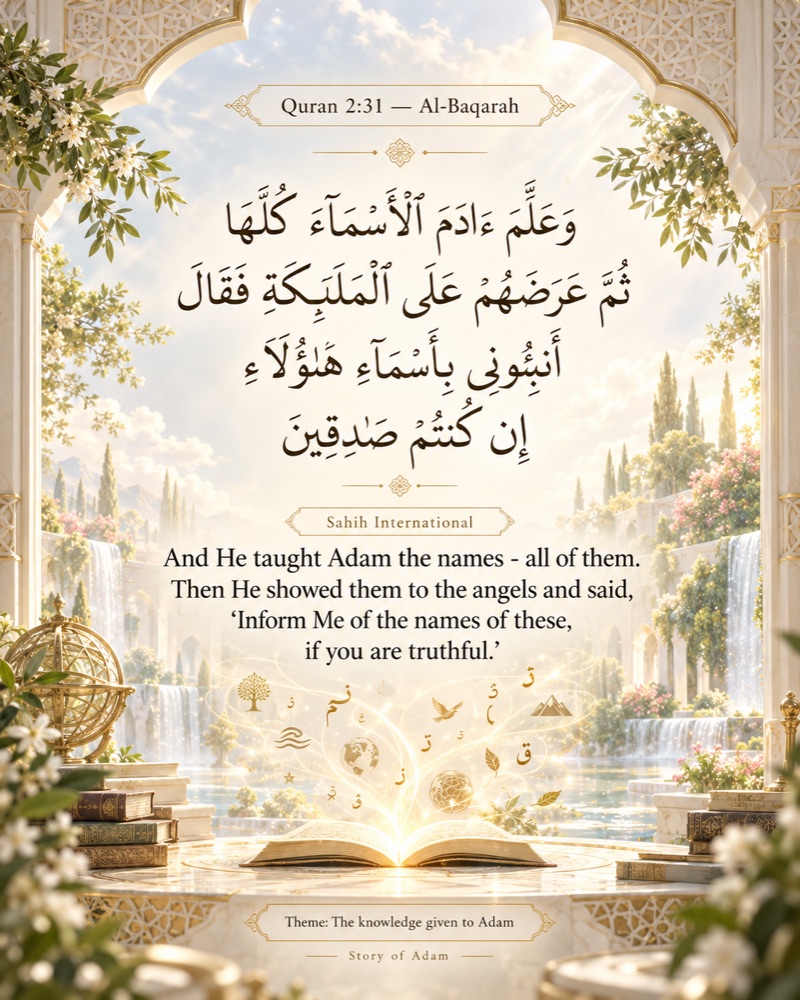
Asking ChatGPT to explain Quran 2:31 (Al-Baqarah), where Allah teaches Adam the names of all things, using Tafsir Ibn Kathir, al-Tabari and al-Qurtubi. Then a poster of the ayah, and a reflection: information is what we acquire, but knowledge is a gift from Allah.
Conversation
Explain the meaning and context of this ayah, with reference to well-known tafsir.
Page: Quran 2:31 — Al-Baqara Link: https://aklogs.io/quran/2#ayah-31
Surah 2, Al-Baqara (The Cow), ayah 31
English (Sahih International): And He taught Adam the names - all of them. Then He showed them to the angels and said, "Inform Me of the names of these, if you are truthful."
Arabic: وَعَلَّمَ ءَادَمَ ٱلْأَسْمَآءَ كُلَّهَا ثُمَّ عَرَضَهُمْ عَلَى ٱلْمَلَٰٓئِكَةِ فَقَالَ أَنۢبِـُٔونِى بِأَسْمَآءِ هَٰٓؤُلَآءِ إِن كُنتُمْ صَٰدِقِينَ
Urdu (Jalandhry): اور اس نے آدم کو سب (چیزوں کے) نام سکھائے پھر ان کو فرشتوں کے سامنے کیا اور فرمایا کہ اگر تم سچے ہو تو مجھے ان کے نام بتاؤ
Note by the site author: Story of Adam.
Surah Al-Baqarah 2:31 — The Knowledge Given to Adam
Central meaning: Allah taught Prophet Adam (AS) knowledge that the angels did not possess. This demonstrated Adam's special position and helped explain why Allah chose to place humanity on Earth as a Khalifah (successive authority).
1. Context: Why did Allah teach Adam?
In the preceding verse (2:30), Allah announced to the angels that He would place a Khalifah on Earth.
The angels asked why Allah would create beings capable of corruption and bloodshed when they themselves continuously glorified Him.
Allah replied:
"Indeed, I know that which you do not know." — Quran 2:30
Then, in verse 31, Allah demonstrated part of that wisdom by teaching Adam the names of things and asking the angels to identify them.
2. What do the classical tafsir say?
Tafsir Ibn Kathir
Ibn Kathir explains that Allah gave Adam knowledge of the names of things, including animals, people, the earth, the sky, and other creations.
He cites Ibn Abbas and other early authorities to explain that this knowledge distinguished Adam from the angels.
The lesson is that Adam was given a special excellence through knowledge.
Tafsir al-Tabari
Al-Tabari discusses different interpretations of al-asma'a kullaha (all the names), including the names of created beings, angels, and Adam's descendants.
He also explains that the question to the angels revealed the limits of their knowledge. If they did not know even the names of what was presented to them, they could not claim full knowledge of the wisdom behind humanity's creation.
Tafsir al-Qurtubi
Al-Qurtubi discusses the meaning of names as expressions identifying things, and reports the view of Ibn Abbas, Mujahid, Qatadah and other scholars that Adam was taught the names of things, both great and small.
This highlights the significance of knowledge and its connection with language.
3. What happens next? (Verses 32–33)
- 2:32 — The angels acknowledge their limitations. They say they have no knowledge except what Allah has taught them.
- 2:33 — Adam identifies the names. Allah commands Adam to inform the angels, demonstrating the knowledge Allah had granted him.
4. The deeper meaning
There are three important lessons:
- Knowledge is a divine gift. Adam did not discover this knowledge independently; Allah taught him.
- Humanity has a special intellectual capacity. The passage demonstrates Adam's knowledge and ability to identify things, although it does not explicitly describe the full extent of human intelligence.
- Knowledge requires humility. Even the angels acknowledged that their understanding was limited to what Allah had taught them.
One important distinction: the classical tafsir primarily explain the verse as Allah teaching Adam the names of created things. The broader idea that this represents humanity's capacity for language, classification, and conceptual knowledge is a reasonable philosophical reflection, but should not be confused with the verse's explicit wording.
5. My interpretation
What makes this ayah especially interesting is that Allah demonstrates Adam's distinction through knowledge, rather than physical strength, power, or even worship.
Naming something enables us to identify it, distinguish it, communicate about it, and organize our understanding of it.
That creates an interesting connection between the Quranic account of Adam and the importance of language in human civilization.
The central lesson is not that humans know everything, but that Allah gave Adam knowledge that the angels did not have. This helps explain the wisdom behind Adam's creation while reminding humanity that its knowledge is ultimately dependent on Allah.
References
@Create image create a poster image
Knowledge is a divine gift.
i like this concept. means what we learn is information and Knowledge is a divine gift. knowledge is a gift of Allah, and when you gets it when He gives you.
Yes. You're making an interesting distinction between information and knowledge.
- Information is what we read, hear, study, and collect.
- Knowledge is what we come to understand.
- Wisdom is knowing how and when to apply that understanding.
Your interpretation is that we can seek information through our own efforts, but true understanding is ultimately a gift from Allah.
This connects beautifully with Quran 2:31:
“And He taught Adam the names—all of them.”
Adam received knowledge because Allah taught him.
And Quran 2:32 reinforces the idea when the angels say:
“We have no knowledge except what You have taught us.”
Your concept, expressed simply
“Information is what we acquire. Knowledge is what Allah grants. We can spend our lives learning, but true understanding comes only by His permission.”
One important nuance: Islam also encourages seeking knowledge through study, observation, and reflection. Divine guidance and human effort are not opposites.
We make the effort to learn. Allah is the ultimate source of our ability to understand.
If you want, I can:
- Explain the distinction between information and divine knowledge
- Describe how seeking knowledge and divine gift relate in Islam
- Reflect on wisdom's role beyond information and knowledge